

 Image 1 of 1
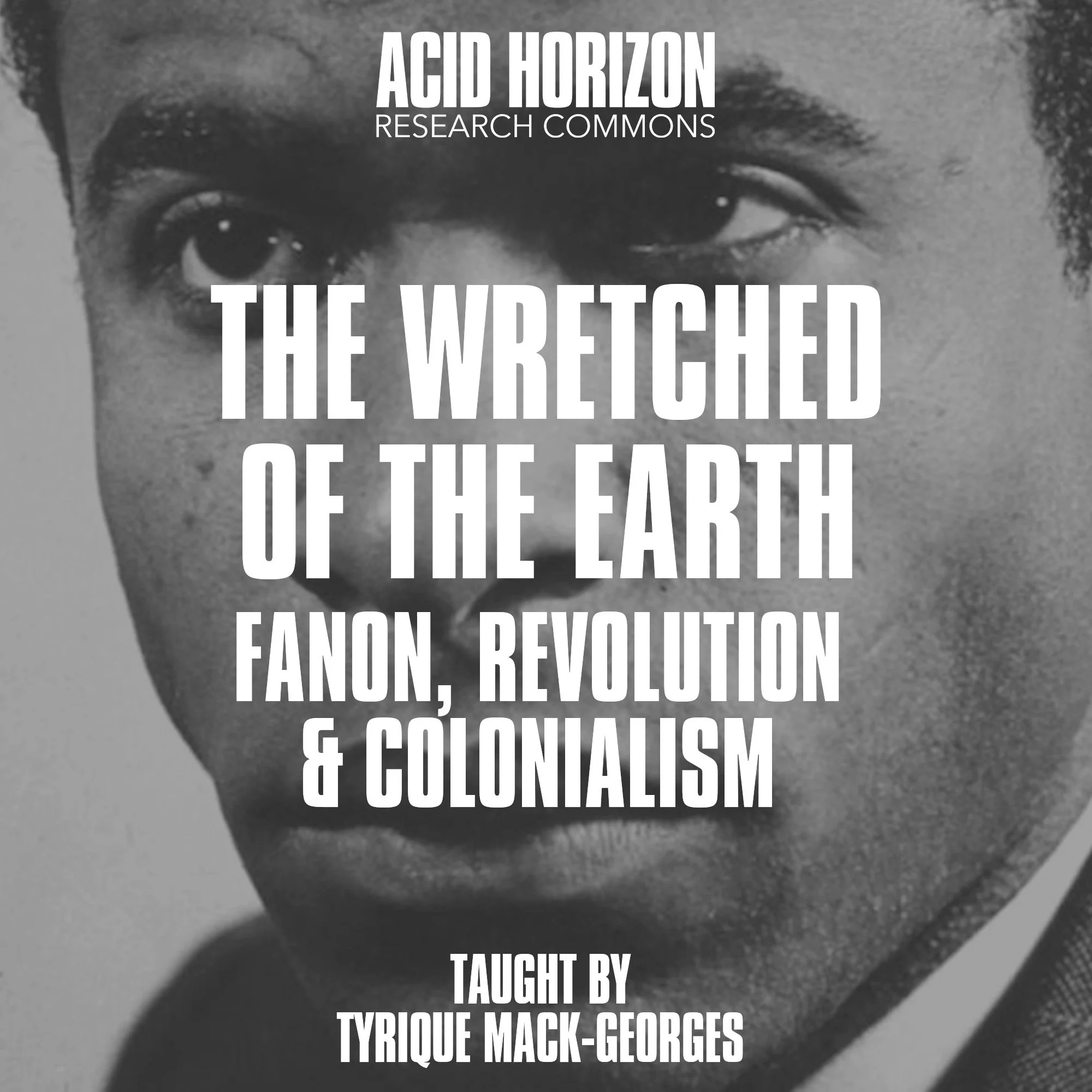
The Wretched of the Earth and Fanon's Dialectical Philosophy
Taught by Tyrique Mack-Georges (Acid Horizon Research Commons)
The Wretched of the Earth begins with a provocation that has never lost its urgency: what if the colonial system is not simply an injustice to be criticized but a totality to be comprehended—and ultimately destroyed? Since its publication in the wake of Frantz Fanon's death in 1961, his final text has generated two competing legacies. The first is political: Wretched became an immediate manifesto for anti-colonial and national liberation movements across the globe, from Ali Shariati in Iran to Steve Biko in South Africa to Malcolm X and Bobby Seale in the United States. The second is theoretical: as the revolutionary energies of the 1960s and 70s receded, the academy absorbed Fanon into the frameworks of Marxism, psychoanalysis, existentialism, postcolonial theory, and critical philosophy of race. Both readings have been indispensable—and both, taken alone, are insufficient.
This four-week seminar proposes a third reading. Wretched of the Earth is, at its core, a work of dialectical philosophy—a form of reason that moves from the abstract toward the concrete in order to render the colonial system historically intelligible. Read alongside the tradition that shaped it—especially the later Jean-Paul Sartre of the Critique of Dialectical Reason—Fanon emerges not merely as activist or theorist but as a dialectical thinker for whom thought and action are inseparable. It is this unification that unlocks what neither purely political nor purely theoretical readings could deliver on their own: a comprehension of Wretched as a living, totalizing philosophy of liberation.
The course moves through four conceptual axes. It begins, unconventionally, not with the famous opening chapter on violence but with Fanon's account of praxis—how isolated colonial masses constitute themselves as revolutionary groups, and why sustaining that movement demands more than spontaneity. From there, the seminar turns to culture, examining Fanon's argument that national culture is not a byproduct of liberation but its essential foundation, tracing the movement from colonial assimilation to combative, revolutionary expression. The third session confronts violence directly—reading "On Violence" alongside "Colonial War and Mental Disorders" to understand how racist language and colonial history jointly structure both the psychological and political dimensions of oppression. The course concludes with Fanon's fragmentary but explosive sketch of a "new humanity": a figure who does not simply think or act in relation to the human, but is called upon to invent the human being anew—liberated from the constraints of European humanism in a gesture that, Fanon insists, is necessary for colonized and colonizer alike.
Throughout, Sartre's Critique of Dialectical Reason serves as a crucial interlocutor, clarifying Fanon's use of seriality, group-in-fusion, praxis, and racist ideas—not as external scaffolding imposed on the text, but as a living dialogue that Fanon himself was actively engaged in.
Course Structure
This four-week seminar moves through Wretched of the Earth along four dialectical moments:
Praxis How exploited colonial masses move from isolation to collective revolutionary agency, read through Fanon's middle chapters alongside Sartre's account of the group-in-fusion.
Culture Fanon's argument for national culture as the foundation of decolonial struggle, tracing the arc from colonial assimilation to a combative, revolutionary literature and cultural practice.
Violence A historically grounded reading of Fanon's most contested chapter, examined alongside the psychiatric case studies of "Colonial War and Mental Disorders" and Sartre's analysis of racist ideas.
New Humanity Fanon's concluding vision of an unfinished, infinite humanism—one that demands the perpetual reinvention of the human being beyond the limits of European tradition.
Instructor Bio
Tyrique Mack-Georges is a PhD student whose work explores the intersection of 20th-century Continental Philosophy—especially existential phenomenology—and the Critical Philosophy of Race. His research centers on Jean-Paul Sartre and Frantz Fanon, through whose work he investigates how racism and colonialism function concretely and what makes them systemic. His secondary interests include 19th-century philosophy, with particular attention to Hegel and Marx.
Course Schedule
All sessions meet from 11:00 AM–12:30 PM EDT via Zoom.
Session 1: June 21 — Praxis
Session 2: June 28 — Culture
Session 3: July 5 — Violence
Session 4: July 12 — New Humanity
Students will receive access to all recorded sessions and supplementary reading materials. Upon enrollment, a recurring Zoom link will be provided to access your classroom.
Taught by Tyrique Mack-Georges (Acid Horizon Research Commons)
The Wretched of the Earth begins with a provocation that has never lost its urgency: what if the colonial system is not simply an injustice to be criticized but a totality to be comprehended—and ultimately destroyed? Since its publication in the wake of Frantz Fanon's death in 1961, his final text has generated two competing legacies. The first is political: Wretched became an immediate manifesto for anti-colonial and national liberation movements across the globe, from Ali Shariati in Iran to Steve Biko in South Africa to Malcolm X and Bobby Seale in the United States. The second is theoretical: as the revolutionary energies of the 1960s and 70s receded, the academy absorbed Fanon into the frameworks of Marxism, psychoanalysis, existentialism, postcolonial theory, and critical philosophy of race. Both readings have been indispensable—and both, taken alone, are insufficient.
This four-week seminar proposes a third reading. Wretched of the Earth is, at its core, a work of dialectical philosophy—a form of reason that moves from the abstract toward the concrete in order to render the colonial system historically intelligible. Read alongside the tradition that shaped it—especially the later Jean-Paul Sartre of the Critique of Dialectical Reason—Fanon emerges not merely as activist or theorist but as a dialectical thinker for whom thought and action are inseparable. It is this unification that unlocks what neither purely political nor purely theoretical readings could deliver on their own: a comprehension of Wretched as a living, totalizing philosophy of liberation.
The course moves through four conceptual axes. It begins, unconventionally, not with the famous opening chapter on violence but with Fanon's account of praxis—how isolated colonial masses constitute themselves as revolutionary groups, and why sustaining that movement demands more than spontaneity. From there, the seminar turns to culture, examining Fanon's argument that national culture is not a byproduct of liberation but its essential foundation, tracing the movement from colonial assimilation to combative, revolutionary expression. The third session confronts violence directly—reading "On Violence" alongside "Colonial War and Mental Disorders" to understand how racist language and colonial history jointly structure both the psychological and political dimensions of oppression. The course concludes with Fanon's fragmentary but explosive sketch of a "new humanity": a figure who does not simply think or act in relation to the human, but is called upon to invent the human being anew—liberated from the constraints of European humanism in a gesture that, Fanon insists, is necessary for colonized and colonizer alike.
Throughout, Sartre's Critique of Dialectical Reason serves as a crucial interlocutor, clarifying Fanon's use of seriality, group-in-fusion, praxis, and racist ideas—not as external scaffolding imposed on the text, but as a living dialogue that Fanon himself was actively engaged in.
Course Structure
This four-week seminar moves through Wretched of the Earth along four dialectical moments:
Praxis How exploited colonial masses move from isolation to collective revolutionary agency, read through Fanon's middle chapters alongside Sartre's account of the group-in-fusion.
Culture Fanon's argument for national culture as the foundation of decolonial struggle, tracing the arc from colonial assimilation to a combative, revolutionary literature and cultural practice.
Violence A historically grounded reading of Fanon's most contested chapter, examined alongside the psychiatric case studies of "Colonial War and Mental Disorders" and Sartre's analysis of racist ideas.
New Humanity Fanon's concluding vision of an unfinished, infinite humanism—one that demands the perpetual reinvention of the human being beyond the limits of European tradition.
Instructor Bio
Tyrique Mack-Georges is a PhD student whose work explores the intersection of 20th-century Continental Philosophy—especially existential phenomenology—and the Critical Philosophy of Race. His research centers on Jean-Paul Sartre and Frantz Fanon, through whose work he investigates how racism and colonialism function concretely and what makes them systemic. His secondary interests include 19th-century philosophy, with particular attention to Hegel and Marx.
Course Schedule
All sessions meet from 11:00 AM–12:30 PM EDT via Zoom.
Session 1: June 21 — Praxis
Session 2: June 28 — Culture
Session 3: July 5 — Violence
Session 4: July 12 — New Humanity
Students will receive access to all recorded sessions and supplementary reading materials. Upon enrollment, a recurring Zoom link will be provided to access your classroom.