
 Image 1 of 1
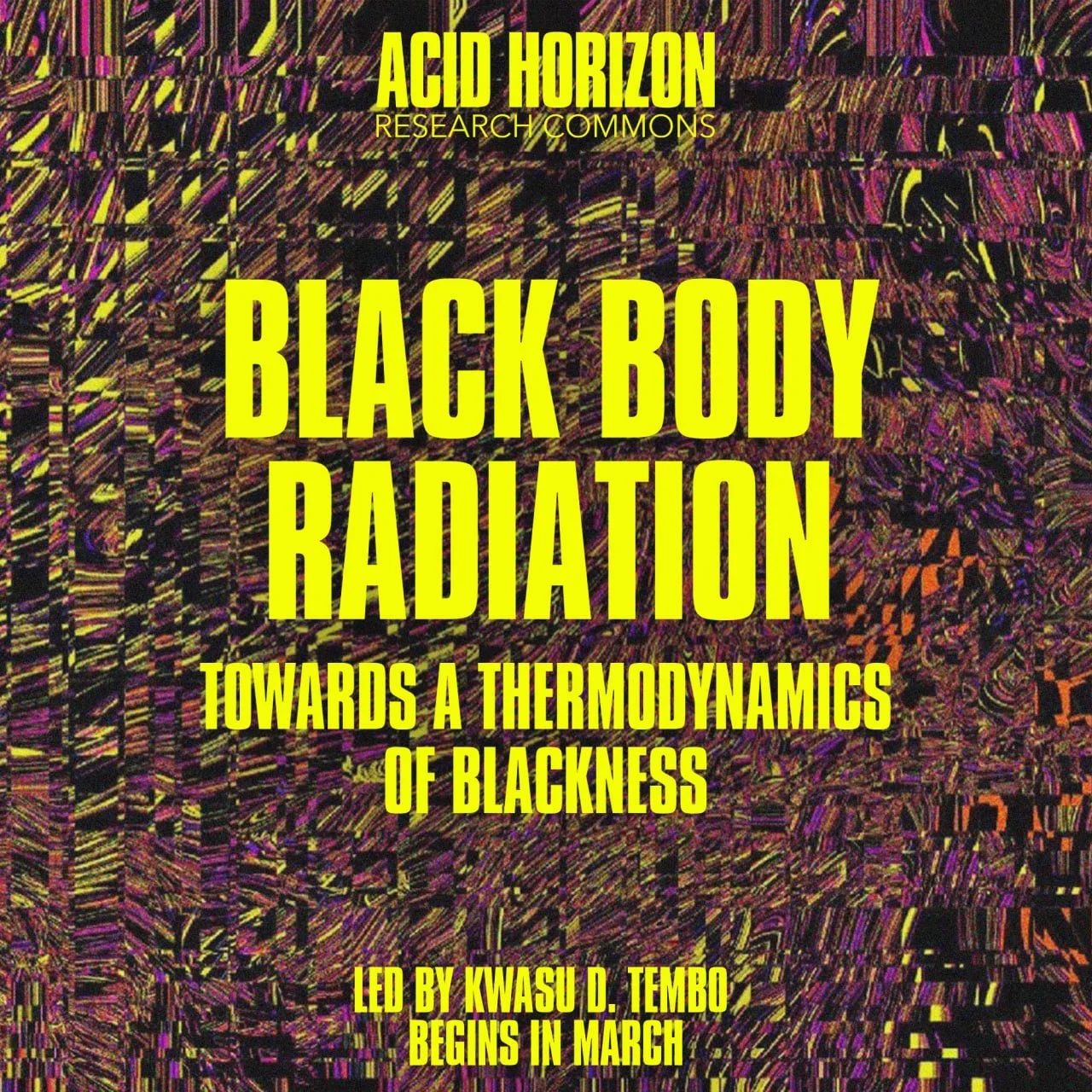
Black Body Radiation: Fanon and Beyond, Toward a Thermodynamics of Blackness
Taught by Kwasu Tembo (Acid Horizon Research Commons)
Spurred on by the lingering question of the so-called “Fact of Blackness” deconstructed and diagnosed by Franz Fanon in Black Skin, White Masks (1952), this course will invite participants to re-investigate and re-theorize the intensity called ‘Blackness’. This course reposes the question of black (well)being through a central palindromic provocation: Being is (de)intensified through Blackness/Blackness is (de)intensified through Being.
Readings draw on Fanon, Kierkegaard, Aria Dean, Sylvia Wynter, and Paul Gilroy among others.
Course Structure
This course will aim to re-think blangst and the intensity called Blackness, taking inspiration from a range of black scholarship investigating the onto-sociegeny of Blackness within a predominantly Afropessimist frame. It will do so by engaging with a theoretical and metaphorical assemblage of concepts drawn from, but not limited to: thermodynamics (understood here as thecadynamics); Afropessimism; Black nihilism, Blacceleration, and what this course will refer to as blacknotechnics – a meta-machinic assay of Blackness as a producer of force and Blackness as something forced to produce. Ultimately, in our seminars, we will attempt to think Blackness as radiating without anxiety.
In the colonial frame of the so-called Commons of Civilization (politics, economics, culture, and ecology) the intensity called ‘Blackness’ coalesces and cools into the form of superficiality. This intensed surface, whose productive property relative to a white imaginary is to delimit said imaginary’s anxious self-(mis)understanding, is specular. The fact of Blackness delineates, succinctly and severely, white subjectivity and its imaginary’s attempt to both instantiate and transcendentalize a negative objectification that turns Black being into Black objects, Black force into non-Black power.
The surface of Blackness thereby becomes an interface whereupon the non-subjectivity and being collapse into racial revenance. From the vantage of the white imaginary, the appearance of the ontic reality of Blackness is terminal; it is the limit of being that Blackness can attain to. Inevitably, this condition contains the being that it demarcates within an ostensibly rigorous ontoexistential experience of specifically Kierkegaardian dread or anxiety, developed in his text The Concept of Anxiety (1844). This “blangst” (black + angst) is subsequently (de)intensified along two meridians. On the one hand, Blackness is, for a variety of purposes of containment, ascribed a form of materialism. On the other hand, and for cognate purposes of obfuscating the radical freedom of Black force, Blackness is ascribed a form of idealism. However, as simultaneously delimited and delimiting products, deferments, and denaturings of the white imaginary and its anxieties, blangst is necessarily a superposition of surreality, pessimism, and future anxiousness around the breaking apart of Blackness as an insufficiency of the white imaginary, the meltdown of the radiative force of Blackness.
If the Afropessimist claim that the postcolonial condition of Blackness is one of revenant life, social death, inhumanity, and a reduction of any chance for subjectivity to permanent fungible objectivity is taken to its radical extremes, one possible line of flight opened up might consider ‘Blackness’, in its most radically dehumanized form, as, ontologically, a type of ‘dark energy’. What results is the intensity of Blackness as a type of ‘rédeation’, a type of “Common radiation” as much as a “Common anxiety”, yet one caught in an tension between the surface of Blackness and its imbrication by the white imaginary, and the always-already force of Blackness, an intensity which, beyond or at the end of the delimitations of a white imaginary and its world, is always-already emitting as much as absorbing, calcinating as well as putrefying, disappearing as much as reappearing as a kind of onto- sociogenic meltdown.
Instructor Bio
Kwasu lives and works in Lancaster, UK. He teaches Global Anglophone Literature and New Media as well as Film at Lancaster University. He is co-founder of international publication project Phasmid Press and currently acts as chairperson for Morecambe-based artist development program and collective Jwllrs. He has published extensively in a variety of international journals, magazines, edited collections, and two single-authored monographs for Bloomsbury. His research interests include but are not limited to: the philosophy of time (travel), consciousness, Object Oriented Ontology, neo-Darwinism, A.I., (de)Intensification, blackness, fascism, (inter)referentiality in music and archive studies, stochasticity, and psycho-sexuality. When not reading anything from The Monk to Swamp Thing, Kwasu makes music under the monikers M.O.T.O and Slimeking.
Course Schedule
All sessions meet from 20:00-21:30 PM GMT via Zoom.
Session 1: March 3 — “The blue and the dim and the dark cloths of night and light and the half-light”: Towards and Beyond a Thermodynamics of Blackness.
Session 2: March 10 — “On Earth, the greatest Undercommons is the Sea: Race, Melanin in Mobili, Technology, and Verne’s 20,000 Leagues Under the Sea”.
Session 3: March 17 — “Niellosarco; or, the Laugh of the Hyena: Towards and Beyond a Weremorphology of Blackness”.
Session 4: March 24 — “What is Andy? Toward and Beyond the Lives of black Technical Objects in Alien: Romulus”.
Students will receive permanent access to all recorded lectures and a recurring Zoom link for all sessions.
Upon enrollment, download the welcome package and use the materials to navigate to your classroom.