

 Image 1 of 1
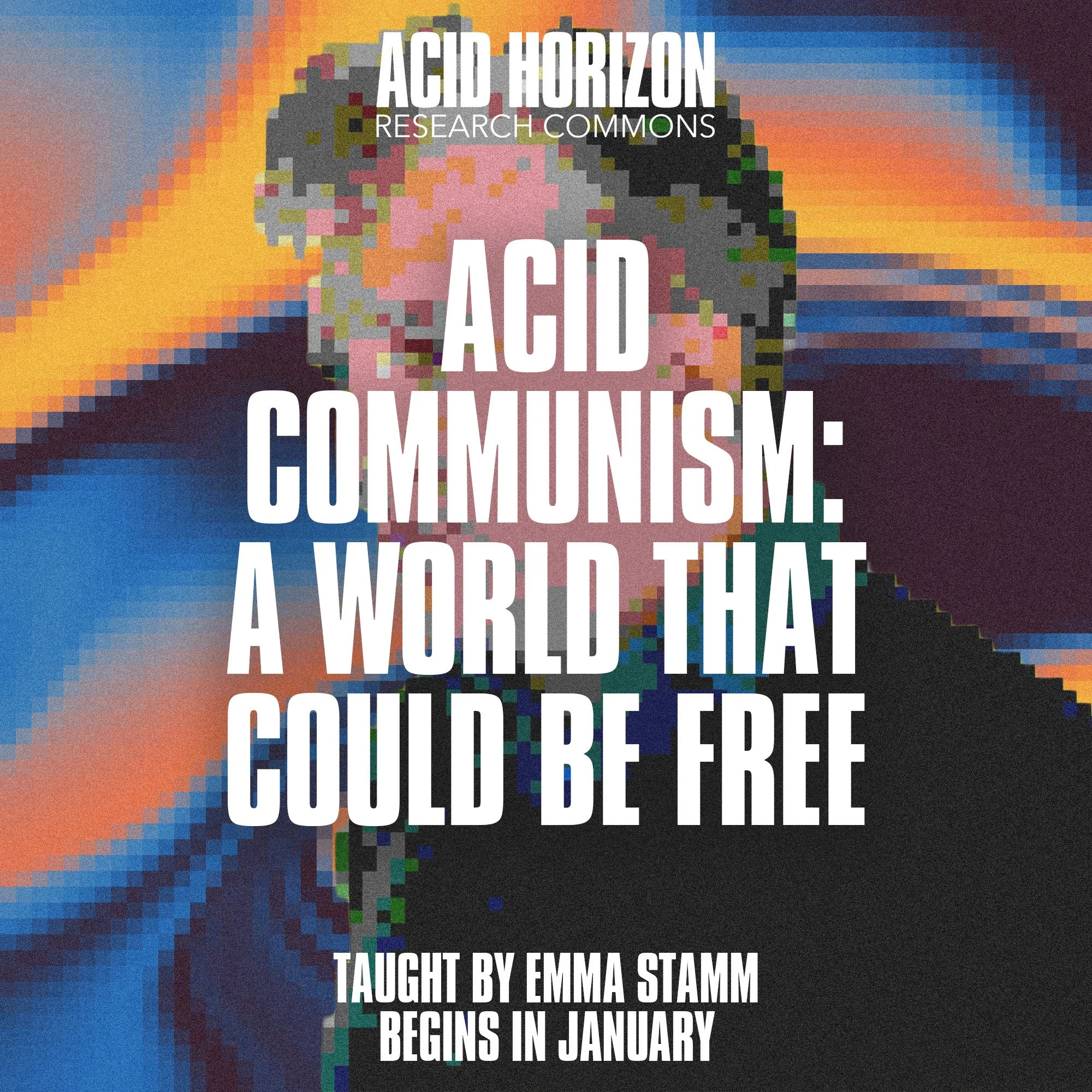
Acid Communism: A World That Could Be Free
Taught by Emma Stamm, PhD (Acid Horizon Research Commons)
“Acid communism is a joke of sorts, but one with very serious purpose.” — Mark Fisher
Acid Communism: A World That Could Be Free departs from the premise of cultural theorist Mark Fisher’s unfinished monograph Acid Communism. In the introduction to that work, Fisher describes a decades-long political campaign that quietly suppressed the radical potential of the 1960s counterculture. His aim was to understand the mechanisms behind this suppression in order to imagine how it might be reversed.
Across four sessions, this course focuses on digital technology as central to that machinery. Drawing on cultural studies, technology criticism, and Fisher’s writings, we will connect the rise of the internet and artificial intelligence to capital’s assault on creativity, strangeness, desire, and friendship. We will also examine music as a form of “counter-exorcism” that preserves radical consciousness in everyday life, and consider the place of psychedelic experience within the acid communist project.
As Fisher suggests, acid communism holds together the lighthearted and the deeply earnest. Our readings and discussions stabilize both dimensions in historical, cultural, and philosophical context. We ask: which events, technologies, and conceptual frameworks made non-capitalist life appear untenable? Can art and visionary experience be drawn into political thought without being reduced to the “merely” political? And what exists, here and now, as a testament against the homogeneity and fatalism that define so much of the present moment?
This course is designed for thinkers of technology, artists, theorists, and anyone who has caught glimpses of something other—and who believes that otherness should be cultivated as a collective good rather than a private escape. It welcomes a creative attitude toward past, present, and future, recognizing our shared role in making them what they are.
Course Structure
This four-week seminar approaches acid communism through a sequence of thematic inquiries:
Aesthetic Thought as Precursor to Politics
Defining acid communism and examining aestheticization as a political force.AI and Other Numbing Agents
Weirdness, eeriness, and the algorithmic conditioning of affect and culture.Touching the Alien
Digital subjectivity, events, and the limits of quantification and abstraction.Acid Communism as Minor Science
Group consciousness, music, drugs, and forms of knowledge beyond instrumental reason.
Instructor Bio
Emma Stamm is a writer and scholar specializing in critical theory and science and technology studies. Her writing has appeared in Real Life, Vice Motherboard, and Communications of the Association for Computing Machinery, among others. She has held teaching appointments at SUNY Farmingdale, Villanova University, New York University, and Virginia Tech. Her work explores the intersections of technology, culture, politics, and contemporary critical theory.
Course Schedule
All sessions meet from 7:00–8:30 PM ET via Zoom.
Session 1: January 6 — Aesthetic Thought as Precursor to Politics
Session 2: January 13 — AI and Other Numbing Agents
Session 3: January 20 — Touching the Alien
Session 4: January 27 — Acid Communism as Minor Science
Students will receive permanent access to all recorded lectures, supplementary readings, and discussion materials.
Taught by Emma Stamm, PhD (Acid Horizon Research Commons)
“Acid communism is a joke of sorts, but one with very serious purpose.” — Mark Fisher
Acid Communism: A World That Could Be Free departs from the premise of cultural theorist Mark Fisher’s unfinished monograph Acid Communism. In the introduction to that work, Fisher describes a decades-long political campaign that quietly suppressed the radical potential of the 1960s counterculture. His aim was to understand the mechanisms behind this suppression in order to imagine how it might be reversed.
Across four sessions, this course focuses on digital technology as central to that machinery. Drawing on cultural studies, technology criticism, and Fisher’s writings, we will connect the rise of the internet and artificial intelligence to capital’s assault on creativity, strangeness, desire, and friendship. We will also examine music as a form of “counter-exorcism” that preserves radical consciousness in everyday life, and consider the place of psychedelic experience within the acid communist project.
As Fisher suggests, acid communism holds together the lighthearted and the deeply earnest. Our readings and discussions stabilize both dimensions in historical, cultural, and philosophical context. We ask: which events, technologies, and conceptual frameworks made non-capitalist life appear untenable? Can art and visionary experience be drawn into political thought without being reduced to the “merely” political? And what exists, here and now, as a testament against the homogeneity and fatalism that define so much of the present moment?
This course is designed for thinkers of technology, artists, theorists, and anyone who has caught glimpses of something other—and who believes that otherness should be cultivated as a collective good rather than a private escape. It welcomes a creative attitude toward past, present, and future, recognizing our shared role in making them what they are.
Course Structure
This four-week seminar approaches acid communism through a sequence of thematic inquiries:
Aesthetic Thought as Precursor to Politics
Defining acid communism and examining aestheticization as a political force.AI and Other Numbing Agents
Weirdness, eeriness, and the algorithmic conditioning of affect and culture.Touching the Alien
Digital subjectivity, events, and the limits of quantification and abstraction.Acid Communism as Minor Science
Group consciousness, music, drugs, and forms of knowledge beyond instrumental reason.
Instructor Bio
Emma Stamm is a writer and scholar specializing in critical theory and science and technology studies. Her writing has appeared in Real Life, Vice Motherboard, and Communications of the Association for Computing Machinery, among others. She has held teaching appointments at SUNY Farmingdale, Villanova University, New York University, and Virginia Tech. Her work explores the intersections of technology, culture, politics, and contemporary critical theory.
Course Schedule
All sessions meet from 7:00–8:30 PM ET via Zoom.
Session 1: January 6 — Aesthetic Thought as Precursor to Politics
Session 2: January 13 — AI and Other Numbing Agents
Session 3: January 20 — Touching the Alien
Session 4: January 27 — Acid Communism as Minor Science
Students will receive permanent access to all recorded lectures, supplementary readings, and discussion materials.