

 Image 1 of 1
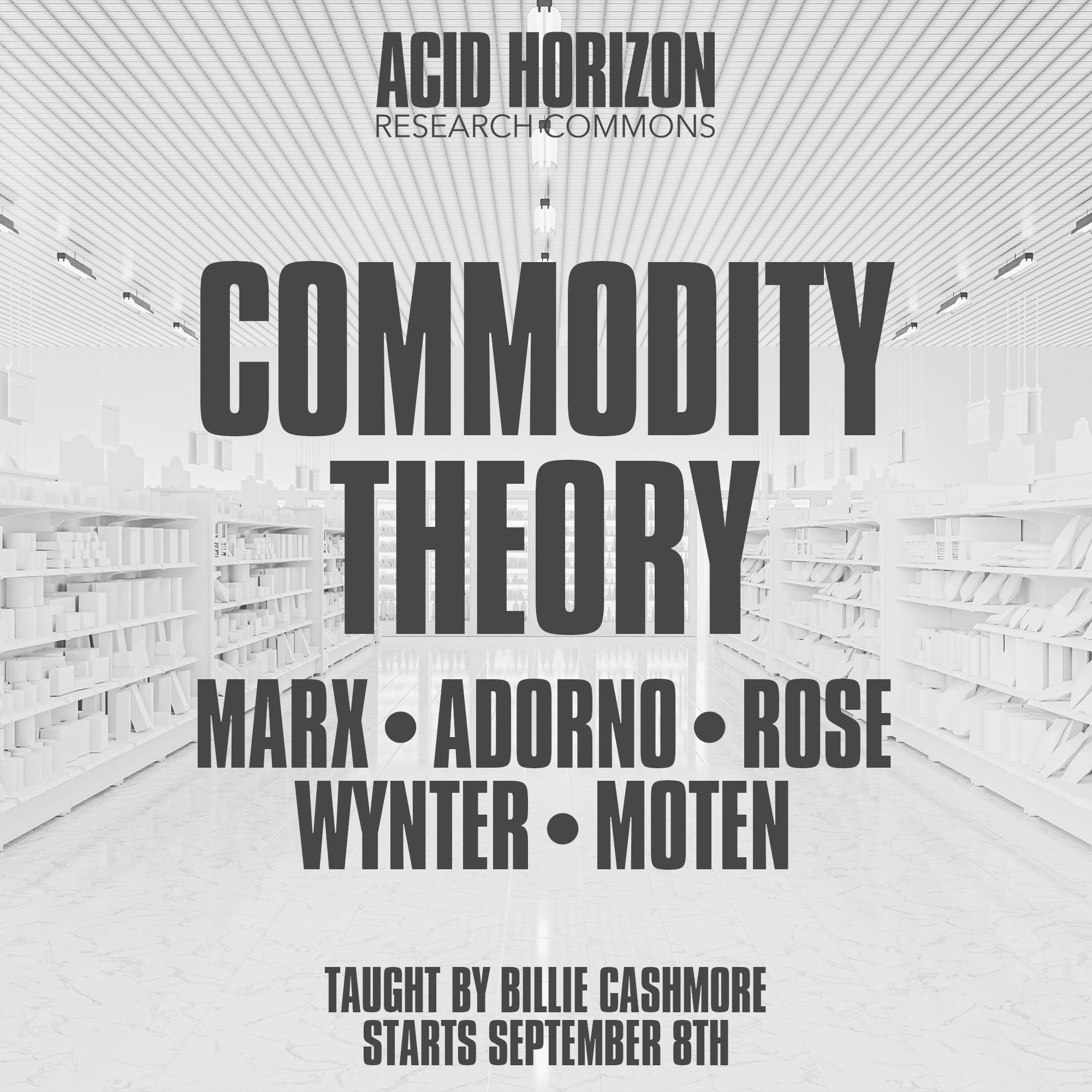
The Commodity: Appearance, Reification and Practice from Karl Marx to Sylvia Wynter
Taught by Billie Cashmore (Acid Horizon Research Commons)
"The wealth of societies dominated by the capitalist mode of production appears in the form of an 'enormous accumulation of commodities.'" After the defeat of the revolution projected in The Communist Manifesto, Marx exasperatedly asked why the Paris proletariat had not risen in revolt. To answer this question, Marx felt it necessary to embark on an intellectual project of a scale rarely equalled in the history of philosophy, a critique of political economy that culminated in Capital, Volume One. That he should have begun with an analysis of society's form of appearance, the commodity, may now be so sedimented in philosophical and political consciousness as to occlude its radicality. This course locates Marx's concept of the commodity as the general form of appearance of capitalist society against a background in post-Kantian philosophy, particularly Kant, Hegel, and Feuerbach.
Locating Marx as such is not entirely innocent, however, and prepares the ground for interpreting the first part of Capital as the methodological basis for critical theory more generally, such that to pose a question to Marx's analysis of the commodity would be to undermine much of the 20th century's attempts to provide a critical theory of society, including the Frankfurt School and feminist accounts of social reproduction. This is how we ought to locate Fred Moten's influential argument in In the Break, that Marx's passing over of the historical reality of the speaking commodity, the slave, might make historical materialism shudder. What would it mean to think the appearance of capitalist society otherwise? What would it mean to locate, as Moten does, a necessarily performative moment in the social that seems both exterior to and necessary within Marx?
Readings draw on Marx's Capital, Volume 1 (throughout), alongside Hegel, Adorno, Gillian Rose, Fred Moten, Sylvia Wynter, and Adrian Piper.
Course Structure
This four-week seminar unfolds through a series of interconnected explorations of the commodity form across appearance, reification, and performance, always returning to Part 1 of Capital:
Appearance: Hegel, Marx
Reading Marx's opening arguments from Capital alongside extracts from Hegel's Encyclopedia Logic and Marx's "On Feuerbach," locating the commodity as the general form of appearance of capitalist society.
Thing/Person: Marx, Adorno, Rose
Turning to Adorno's appropriation of Lukács's emphasis on reification, alongside the often-overlooked twin category of personification, with Gillian Rose's account of Adorno's thought as a guide.
Thing/Person: Marx, Moten
Turning to Fred Moten's "Resistance of the Object: Aunt Hester's Scream," thinking both its inheritance of and departure from the problematics of Marx, Lukács, and Adorno.
Person/Performance: Wynter, Moten, Piper
Discussing sections of Sylvia Wynter's unpublished Black Metamorphosis alongside Moten's "Resistance of the Object: Adrian Piper's Theatricality," to think the centrality of performance to a 21st-century theory of society, and in particular the connection between performance and praxis.
Instructor Bio
Billie Cashmore is a PhD researcher at CRMEP, working on the relation between Marxism and the Black radical tradition on the question of value. Her work focuses on questions of narrative, relation, and appearance. She is the author of We Hear Only Ourselves: Utopia, Memory and Resistance (Zer0 Books, 2023).
Course Schedule
All sessions meet from 3:00–4:30 PM Eastern Time via Zoom.
Session 1: September 8 — Appearance: Hegel, Marx
Session 2: September 15 — Thing/Person: Marx, Adorno, Rose
Session 3: September 22 — Thing/Person: Marx, Moten
Session 4: September 29 — Person/Performance: Wynter, Moten, Piper
Students will receive permanent access to all recorded lectures and a recurring Zoom link for all sessions.
Upon enrollment, download the welcome package and use the materials to navigate to your classroom.
Taught by Billie Cashmore (Acid Horizon Research Commons)
"The wealth of societies dominated by the capitalist mode of production appears in the form of an 'enormous accumulation of commodities.'" After the defeat of the revolution projected in The Communist Manifesto, Marx exasperatedly asked why the Paris proletariat had not risen in revolt. To answer this question, Marx felt it necessary to embark on an intellectual project of a scale rarely equalled in the history of philosophy, a critique of political economy that culminated in Capital, Volume One. That he should have begun with an analysis of society's form of appearance, the commodity, may now be so sedimented in philosophical and political consciousness as to occlude its radicality. This course locates Marx's concept of the commodity as the general form of appearance of capitalist society against a background in post-Kantian philosophy, particularly Kant, Hegel, and Feuerbach.
Locating Marx as such is not entirely innocent, however, and prepares the ground for interpreting the first part of Capital as the methodological basis for critical theory more generally, such that to pose a question to Marx's analysis of the commodity would be to undermine much of the 20th century's attempts to provide a critical theory of society, including the Frankfurt School and feminist accounts of social reproduction. This is how we ought to locate Fred Moten's influential argument in In the Break, that Marx's passing over of the historical reality of the speaking commodity, the slave, might make historical materialism shudder. What would it mean to think the appearance of capitalist society otherwise? What would it mean to locate, as Moten does, a necessarily performative moment in the social that seems both exterior to and necessary within Marx?
Readings draw on Marx's Capital, Volume 1 (throughout), alongside Hegel, Adorno, Gillian Rose, Fred Moten, Sylvia Wynter, and Adrian Piper.
Course Structure
This four-week seminar unfolds through a series of interconnected explorations of the commodity form across appearance, reification, and performance, always returning to Part 1 of Capital:
Appearance: Hegel, Marx
Reading Marx's opening arguments from Capital alongside extracts from Hegel's Encyclopedia Logic and Marx's "On Feuerbach," locating the commodity as the general form of appearance of capitalist society.
Thing/Person: Marx, Adorno, Rose
Turning to Adorno's appropriation of Lukács's emphasis on reification, alongside the often-overlooked twin category of personification, with Gillian Rose's account of Adorno's thought as a guide.
Thing/Person: Marx, Moten
Turning to Fred Moten's "Resistance of the Object: Aunt Hester's Scream," thinking both its inheritance of and departure from the problematics of Marx, Lukács, and Adorno.
Person/Performance: Wynter, Moten, Piper
Discussing sections of Sylvia Wynter's unpublished Black Metamorphosis alongside Moten's "Resistance of the Object: Adrian Piper's Theatricality," to think the centrality of performance to a 21st-century theory of society, and in particular the connection between performance and praxis.
Instructor Bio
Billie Cashmore is a PhD researcher at CRMEP, working on the relation between Marxism and the Black radical tradition on the question of value. Her work focuses on questions of narrative, relation, and appearance. She is the author of We Hear Only Ourselves: Utopia, Memory and Resistance (Zer0 Books, 2023).
Course Schedule
All sessions meet from 3:00–4:30 PM Eastern Time via Zoom.
Session 1: September 8 — Appearance: Hegel, Marx
Session 2: September 15 — Thing/Person: Marx, Adorno, Rose
Session 3: September 22 — Thing/Person: Marx, Moten
Session 4: September 29 — Person/Performance: Wynter, Moten, Piper
Students will receive permanent access to all recorded lectures and a recurring Zoom link for all sessions.
Upon enrollment, download the welcome package and use the materials to navigate to your classroom.