

 Image 1 of 1
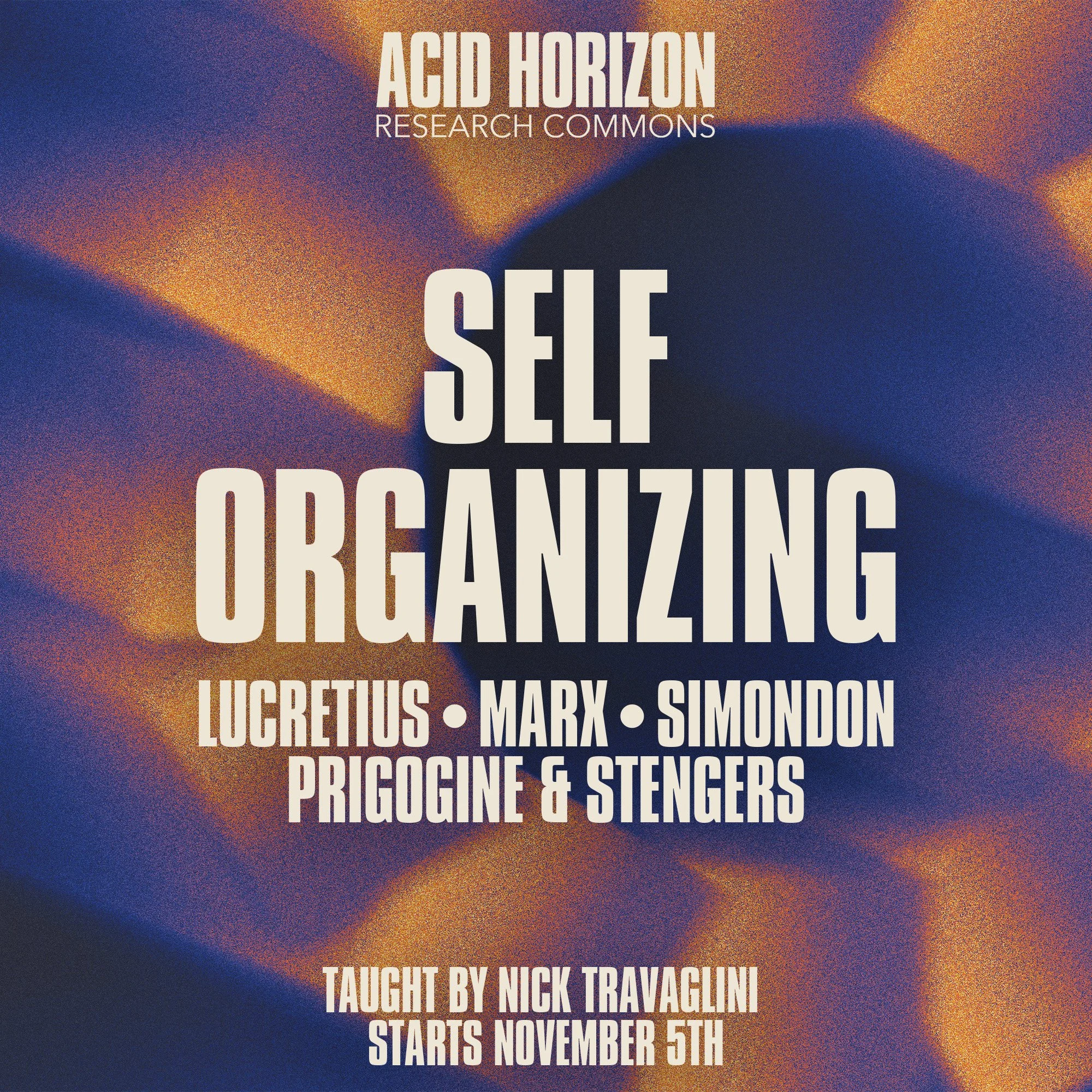
Self Organizing: Lucretius, Marx, Simondon, Prigogine & Stengers
Taught by Nick Travaglini (Acid Horizon Research Commons)
This course explores the phenomenon of autonomy, or self-organization. Creation, independence, and interdependence are abiding themes in human thought, binding together the cosmological and the ethical. Depending on one's theory of self-organization, vastly different ways of life present themselves as personally permissible or sensical.
Beginning with contemporary philosophical and scientific reflections on the topic, students engage with research into an historic account of self-organization as well as its afterlives. They then consider the material conditions that have led people to think differently about self-organization, focused on the 19th and 20th centuries, coming to see it as something they can actively engage with and intervene in, for better or worse. Finally, students have the chance to engage with a form of self-organization in the class and beyond.
Readings draw on Cilliers, Prigogine & Stengers, Lucretius, Thomas Nail, Cara New Daggett, Simondon, J. Stephen Lansing, D.D. Woods, and firsthand accounts of the Prison Literature Project, among others.
Course Structure
This five-week seminar unfolds through a series of interconnected explorations of self-organization across philosophy, history, science, and practice:
Introduction
Students gain a general, and therefore transdisciplinary, understanding of the concept of self-organization. The lecture reviews assigned material and discusses it in the abstract, though constant references to concrete instantiations run through the assigned readings, setting the tone for the remaining weeks.
A Historical Perspective
The subject of this lecture is Lucretius's De Rerum Natura. The class engages with this thoroughly materialist philosophy and thinkers who have made use of it, like Karl Marx and Thomas Nail, focusing on the interpretive richness inherent in the text and the theory espoused therein.
The Place of Technoscience
Self-organization and notions of complexity have gained prominence in human thinking in the wake of certain changes in human practice. This lecture delves into those changes and attempts to isolate the particular theoretical movement they have engendered.
Human et al. Relations
This lecture looks at examples of self-organization that involve what is commonly understood as the human, drawing attention to the principles necessary to engage with and purposely sustain self-organization.
Living Self-Organization
A guest speaker joins to discuss their experience in an ongoing self-organized project — a lead coordinator of the Prison Literature Project, speaking to its history and current operating practices, with an opportunity for Q&A and open discussion between the guest and students.
Final Assignment: Go Organize Something. The class concludes with an ungraded assignment for students to utilize their power to make a difference in the form of beginning a new venture.
Instructor Bio
Nick Travaglini is a worker and organizer based in the San Francisco Bay Area. He holds an MA in Liberal Studies from the New School for Social Research and a BA in Philosophy from UC Berkeley. Concepts central to his thinking include complexity, flourishing, information, and resilience.
Course Schedule
All sessions meet from 5:00–7:00 PM PT via Zoom.
Session 1: November 5 — Introduction
Session 2: November 12 — A Historical Perspective
Session 3: November 19 — The Place of Technoscience
Session 4: December 3 — Human et al. Relations
Session 5: December 10 — Living Self-Organization
Students will receive permanent access to all recorded lectures and a recurring Zoom link for all sessions.
Upon enrollment, download the welcome package and use the materials to navigate to your classroom.
Taught by Nick Travaglini (Acid Horizon Research Commons)
This course explores the phenomenon of autonomy, or self-organization. Creation, independence, and interdependence are abiding themes in human thought, binding together the cosmological and the ethical. Depending on one's theory of self-organization, vastly different ways of life present themselves as personally permissible or sensical.
Beginning with contemporary philosophical and scientific reflections on the topic, students engage with research into an historic account of self-organization as well as its afterlives. They then consider the material conditions that have led people to think differently about self-organization, focused on the 19th and 20th centuries, coming to see it as something they can actively engage with and intervene in, for better or worse. Finally, students have the chance to engage with a form of self-organization in the class and beyond.
Readings draw on Cilliers, Prigogine & Stengers, Lucretius, Thomas Nail, Cara New Daggett, Simondon, J. Stephen Lansing, D.D. Woods, and firsthand accounts of the Prison Literature Project, among others.
Course Structure
This five-week seminar unfolds through a series of interconnected explorations of self-organization across philosophy, history, science, and practice:
Introduction
Students gain a general, and therefore transdisciplinary, understanding of the concept of self-organization. The lecture reviews assigned material and discusses it in the abstract, though constant references to concrete instantiations run through the assigned readings, setting the tone for the remaining weeks.
A Historical Perspective
The subject of this lecture is Lucretius's De Rerum Natura. The class engages with this thoroughly materialist philosophy and thinkers who have made use of it, like Karl Marx and Thomas Nail, focusing on the interpretive richness inherent in the text and the theory espoused therein.
The Place of Technoscience
Self-organization and notions of complexity have gained prominence in human thinking in the wake of certain changes in human practice. This lecture delves into those changes and attempts to isolate the particular theoretical movement they have engendered.
Human et al. Relations
This lecture looks at examples of self-organization that involve what is commonly understood as the human, drawing attention to the principles necessary to engage with and purposely sustain self-organization.
Living Self-Organization
A guest speaker joins to discuss their experience in an ongoing self-organized project — a lead coordinator of the Prison Literature Project, speaking to its history and current operating practices, with an opportunity for Q&A and open discussion between the guest and students.
Final Assignment: Go Organize Something. The class concludes with an ungraded assignment for students to utilize their power to make a difference in the form of beginning a new venture.
Instructor Bio
Nick Travaglini is a worker and organizer based in the San Francisco Bay Area. He holds an MA in Liberal Studies from the New School for Social Research and a BA in Philosophy from UC Berkeley. Concepts central to his thinking include complexity, flourishing, information, and resilience.
Course Schedule
All sessions meet from 5:00–7:00 PM PT via Zoom.
Session 1: November 5 — Introduction
Session 2: November 12 — A Historical Perspective
Session 3: November 19 — The Place of Technoscience
Session 4: December 3 — Human et al. Relations
Session 5: December 10 — Living Self-Organization
Students will receive permanent access to all recorded lectures and a recurring Zoom link for all sessions.
Upon enrollment, download the welcome package and use the materials to navigate to your classroom.