

 Image 1 of 1
Everydayness and Resistance in Japan: Miki Kiyoshi and Tosaka Jun's Critique of Ideology
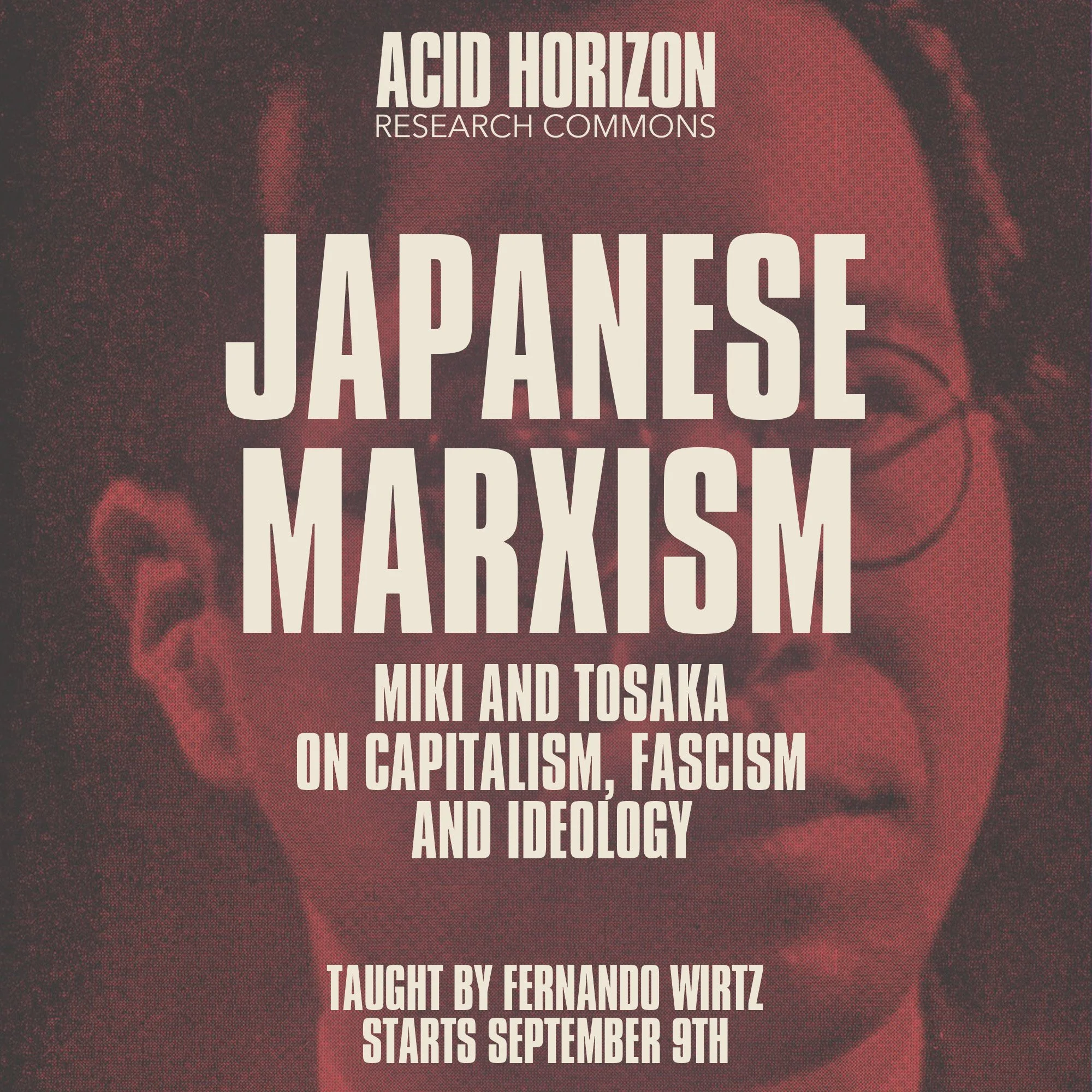
Taught by Fernando Wirtz (Acid Horizon Research Commons)
In 1945, two of Japan's most brilliant Marxist philosophers died in prison. Miki Kiyoshi (1897–1945) and Tosaka Jun (1900–1945) had spent the previous decade developing radical critiques of capitalism, fascism, and ideology while under constant state surveillance. They analyzed how capitalism operates not just as an economic system but as a total colonization of human existence — shaping our fundamental experience, our thought patterns, our myths, and our imagination.
"Everydayness and Resistance in Japan" explores their philosophy from the ground up: How does capitalism shape existence? How does ideology work through material practices, not just as "false consciousness"? How do political myths naturalize domination and open possibilities to dislocate hegemony? And how do we resist when resistance itself seems impossible? These questions haunted 1930s Japan under fascism. They haunt us now under late capitalism.
Readings draw on Miki Kiyoshi, Tosaka Jun, Harootunian, Fujita, Krummel, Yoshimoto, and Ward, among others.
Course Structure
This four-week seminar unfolds through a series of interconnected explorations of Miki and Tosaka's critique of ideology across ontology, everydayness, myth, and praxis:
Miki Kiyoshi's Labor-Oriented Ontology
A brief introduction to the Kyoto School and the life and work of Miki Kiyoshi. Against his teacher Nishida's "pure experience," Miki insists on the materiality and sociality of existence — we exist through productive engagement with the world, and capitalism alienates us not just from products but from existence itself. Exploring Miki's concept of fundamental experience, developed in reaction to Heidegger's Grunderfahrung, as existence understood not as individual experience but as material negotiation with the world.
Tosaka Jun and the Principle of Everydayness
The life and work of Tosaka Jun, centered on his 1930 book The Logic of Ideology. For Tosaka, ideology is not "false consciousness" but is enacted through material practices, institutions, and everyday routines — you don't believe in meritocracy and then act accordingly, you act meritocratically and the ideology emerges from the practice. Taking up the concept of everydayness and journalism: for Tosaka, as for Gramsci, common sense holds revolutionary potential, and historical time originates not in great heroes or battles but in the daily rhythm of work, making journalism a central weapon of resistance.
Inverted Myths: Towards a Logic of Resistance
Examining myth, utopia, and ideology through Sorel's concepts of myth and utopia — utopia requires justification and persuasion, while myth operates pre-politically, disrupting hegemonic discourse. Taking up the Japanese Romantic School's mythmaking around Japan's greatness, and fascism's dangerous appropriation of revolutionary aesthetics and anti-capitalist rhetoric. Asking when collective myths become toxic, as Miki and Tosaka analyzed how Japanese fascism weaponized myth — the emperor system, national essence, anti-Western sentiment — while maintaining capitalist relations.
Tenkō (Conversion) and the Limits of Ideology
Considering the mass phenomenon of 1930s Japan, in which Marxists, anarchists, and leftists publicly converted under torture or threat of indefinite imprisonment. Under extreme state violence, social isolation, and economic precarity, many Japanese Marxists underwent tenkō, publicly renouncing their beliefs; Tosaka refused, and Miki, though accused, denied it — both died for their convictions. Asking what this teaches us about resistance under conditions that seem total, and examining Miki's later turn to "cooperativism" as either a sign of tenkō or a populist attempt to change the system from within.
Instructor Bio
Dr. Fernando Wirtz studied philosophy in Buenos Aires (Argentina) and holds a PhD from the University of Tübingen (Germany). He is Assistant Professor in the Joint Degree in Transcultural Studies at Kyoto University, where he teaches and researches at the intersection of European and non-Western philosophical traditions, drawing on German Idealism, Japanese philosophy, and Latin American philosophy to explore questions of subjectivity, cultural difference, and political thought across traditions. He is a board member of the Society for Intercultural Philosophy (GIP). His books include Myth and Ideology: An Essay on Philosophy of Political Action in Japan (2023), Phänomenologie der Angst: Symbolik und Mythologie bei F.W.J. Schelling und F. Creuzer (2022), and Philosophie in Lateinamerika: Eine Einführung (2024). He is also co-editor of Después de la nada: dialéctica e ideología en la filosofía japonesa contemporánea (Herder, 2023) and Miki Kiyoshi and the Crisis of Thought (2024).
Course Schedule
All sessions meet from 7:00–8:30 PM EST via Zoom.
Session 1: September 9 — Miki Kiyoshi's Labor-Oriented Ontology
Session 2: September 16 — Tosaka Jun and the Principle of Everydayness
Session 3: September 23 — Inverted Myths: Towards a Logic of Resistance
Session 4: September 30 — Tenkō (Conversion) and the Limits of Ideology
Students will receive permanent access to all recorded lectures and a recurring Zoom link for all sessions.
Upon enrollment, download the welcome package and use the materials to navigate to your classroom.
Taught by Fernando Wirtz (Acid Horizon Research Commons)
In 1945, two of Japan's most brilliant Marxist philosophers died in prison. Miki Kiyoshi (1897–1945) and Tosaka Jun (1900–1945) had spent the previous decade developing radical critiques of capitalism, fascism, and ideology while under constant state surveillance. They analyzed how capitalism operates not just as an economic system but as a total colonization of human existence — shaping our fundamental experience, our thought patterns, our myths, and our imagination.
"Everydayness and Resistance in Japan" explores their philosophy from the ground up: How does capitalism shape existence? How does ideology work through material practices, not just as "false consciousness"? How do political myths naturalize domination and open possibilities to dislocate hegemony? And how do we resist when resistance itself seems impossible? These questions haunted 1930s Japan under fascism. They haunt us now under late capitalism.
Readings draw on Miki Kiyoshi, Tosaka Jun, Harootunian, Fujita, Krummel, Yoshimoto, and Ward, among others.
Course Structure
This four-week seminar unfolds through a series of interconnected explorations of Miki and Tosaka's critique of ideology across ontology, everydayness, myth, and praxis:
Miki Kiyoshi's Labor-Oriented Ontology
A brief introduction to the Kyoto School and the life and work of Miki Kiyoshi. Against his teacher Nishida's "pure experience," Miki insists on the materiality and sociality of existence — we exist through productive engagement with the world, and capitalism alienates us not just from products but from existence itself. Exploring Miki's concept of fundamental experience, developed in reaction to Heidegger's Grunderfahrung, as existence understood not as individual experience but as material negotiation with the world.
Tosaka Jun and the Principle of Everydayness
The life and work of Tosaka Jun, centered on his 1930 book The Logic of Ideology. For Tosaka, ideology is not "false consciousness" but is enacted through material practices, institutions, and everyday routines — you don't believe in meritocracy and then act accordingly, you act meritocratically and the ideology emerges from the practice. Taking up the concept of everydayness and journalism: for Tosaka, as for Gramsci, common sense holds revolutionary potential, and historical time originates not in great heroes or battles but in the daily rhythm of work, making journalism a central weapon of resistance.
Inverted Myths: Towards a Logic of Resistance
Examining myth, utopia, and ideology through Sorel's concepts of myth and utopia — utopia requires justification and persuasion, while myth operates pre-politically, disrupting hegemonic discourse. Taking up the Japanese Romantic School's mythmaking around Japan's greatness, and fascism's dangerous appropriation of revolutionary aesthetics and anti-capitalist rhetoric. Asking when collective myths become toxic, as Miki and Tosaka analyzed how Japanese fascism weaponized myth — the emperor system, national essence, anti-Western sentiment — while maintaining capitalist relations.
Tenkō (Conversion) and the Limits of Ideology
Considering the mass phenomenon of 1930s Japan, in which Marxists, anarchists, and leftists publicly converted under torture or threat of indefinite imprisonment. Under extreme state violence, social isolation, and economic precarity, many Japanese Marxists underwent tenkō, publicly renouncing their beliefs; Tosaka refused, and Miki, though accused, denied it — both died for their convictions. Asking what this teaches us about resistance under conditions that seem total, and examining Miki's later turn to "cooperativism" as either a sign of tenkō or a populist attempt to change the system from within.
Instructor Bio
Dr. Fernando Wirtz studied philosophy in Buenos Aires (Argentina) and holds a PhD from the University of Tübingen (Germany). He is Assistant Professor in the Joint Degree in Transcultural Studies at Kyoto University, where he teaches and researches at the intersection of European and non-Western philosophical traditions, drawing on German Idealism, Japanese philosophy, and Latin American philosophy to explore questions of subjectivity, cultural difference, and political thought across traditions. He is a board member of the Society for Intercultural Philosophy (GIP). His books include Myth and Ideology: An Essay on Philosophy of Political Action in Japan (2023), Phänomenologie der Angst: Symbolik und Mythologie bei F.W.J. Schelling und F. Creuzer (2022), and Philosophie in Lateinamerika: Eine Einführung (2024). He is also co-editor of Después de la nada: dialéctica e ideología en la filosofía japonesa contemporánea (Herder, 2023) and Miki Kiyoshi and the Crisis of Thought (2024).
Course Schedule
All sessions meet from 7:00–8:30 PM EST via Zoom.
Session 1: September 9 — Miki Kiyoshi's Labor-Oriented Ontology
Session 2: September 16 — Tosaka Jun and the Principle of Everydayness
Session 3: September 23 — Inverted Myths: Towards a Logic of Resistance
Session 4: September 30 — Tenkō (Conversion) and the Limits of Ideology
Students will receive permanent access to all recorded lectures and a recurring Zoom link for all sessions.
Upon enrollment, download the welcome package and use the materials to navigate to your classroom.